Sunday, October 31, 2010

Halloween Reading

Happy Halloween! Have you done or are you doing anything special for Halloween? We don't go crazy at home but we still decorate a little bit and we do carve one or two pumpkins. Just to welcome trick-or-treating kids and to create some atmosphere (You can see my prize-winning pumpkin on the left :) ).

Back to the books! I've recently received a few books that suit perfectly this time of the year (except maybe the last one, but I included it in the below list as I think I'm going to like it very much):

The End of The Line
edited by Jonathan Oliver

Paperback: 374 pages
Publisher: Solaris (1 Nov 2010)
ISBN-10: 1907519327
ISBN-13: 978-1907519321

New horror stories set on and around the Underground
In deep tunnels something stirs, borne on a warm breath of wind, reeking of diesel and blood. The spaces between stations hold secrets too terrible for the upper world to comprehend and the steel lines sing with the songs of the dead.

The End of The Line collects some of the very best in new horror writing in an themed anthology of stories set on, and around, the Underground, the Metro and other places deep below. This collection of 19 new stories includes thoughtful, disturbing and terrifying tales by Ramsey Campbell, Christopher Fowler, Mark Morris, Pat Cadigan, Adam Nevill and Michael Marshall Smith amongst many others.

Best of Tomes of the Dead
edited by Jonathan Oliver
featuring Matthew Smith, Al Ewing & Rebecca Levene

Paperback: 671 pages
Publisher: Abaddon (11 Nov 2010)
ISBN-10: 1907519343
ISBN-13: 978-1907519345

A Collection of Three Terrifying Zombie Tales

The Zombie Apocalypse Starts Here...

The masters of flesh-munchingly, gut-wrenchingly, eyeball-poppingly great zombie fiction bring you three of the best books from the first years of the critically-acclaimed Tomes of the Dead line.

The Words of Their Roaring
In a London overrun by the zombie hordes, former thief Gabe O'Connell's loyalty to his employer Harry Flowers is challenged when a routine job goes south and he uncovers the full extent of the gang lord's plans for the city.

I, Zombie
John Doe has been dead for then years. If the price is right, he'll kill for you, steal for you, or save your life for you. There's no mystery you can't hire him to solve... except for the secret behind his own existence. A secret that could end all life on Earth.

Anno Mortis
Beautiful and deadly, the gladiator Boda is brought to Rome in the reign of Caligula, where she uncovers a plot to breach the barrier between life and death. For all that she hates her captors and their decadent city, she may be the empire's only hope.

The Pan Book of Horror Stories
selected by Herbert van Thal

Paperback: 300 pages
Publisher: Pan (1 Oct 2010)
ISBN-10: 0330518682
ISBN-13: 978-0330518680

Fifty years ago Pan launched a series of books that were to delight and disgust - sometimes even on the same page – readers for thirty years. From classics in the genre to scraping-the-barrel nastiness, the Pan Books of Horror had them all and they continue to be a major influence in published anthologies to the present day.

We're delighted, therefore, to announce the reissue of the very first Pan Book of Horror. Specially selected for Pan, here are 22 terrifying tales of horror by such famous authors as Peter Fleming, C. S. Forester, Bram Stoker, Angus Wilson, Noel Langley, Jack Finney and L. P. Hartley.

Stories of the uncanny jostle with tales of the macabre. Stories of subtle beastliness---like Rasberry Jam; of sickening horror---like The Fly or His Beautiful Hands; and of utter chilling terror---like The Horror of the Museum!

The perfect bedside book---for those with nerves of steel!

Pax Britannia: The Ulysses Quicksilver Omnibus
by Jonathan Green

Paperback: 734 pages
Publisher: Abaddon (11 Nov 2010)
ISBN-10: 190751936X
ISBN-13: 978-1907519369

Action and adventure in a new age of steam.

Join Ulysses Quicksilver - dandy, adventurer and agent of the crown - as he battles the enemies of the Empire in this collection of rip-roaring steampunk adventures. This action-packed tome brings you three sensational tales...

This omnibus collects together the first three Ulysses Quicksilver novels: Unnatural History, Leviathan Rising and Human Nature.

Monday, October 18, 2010

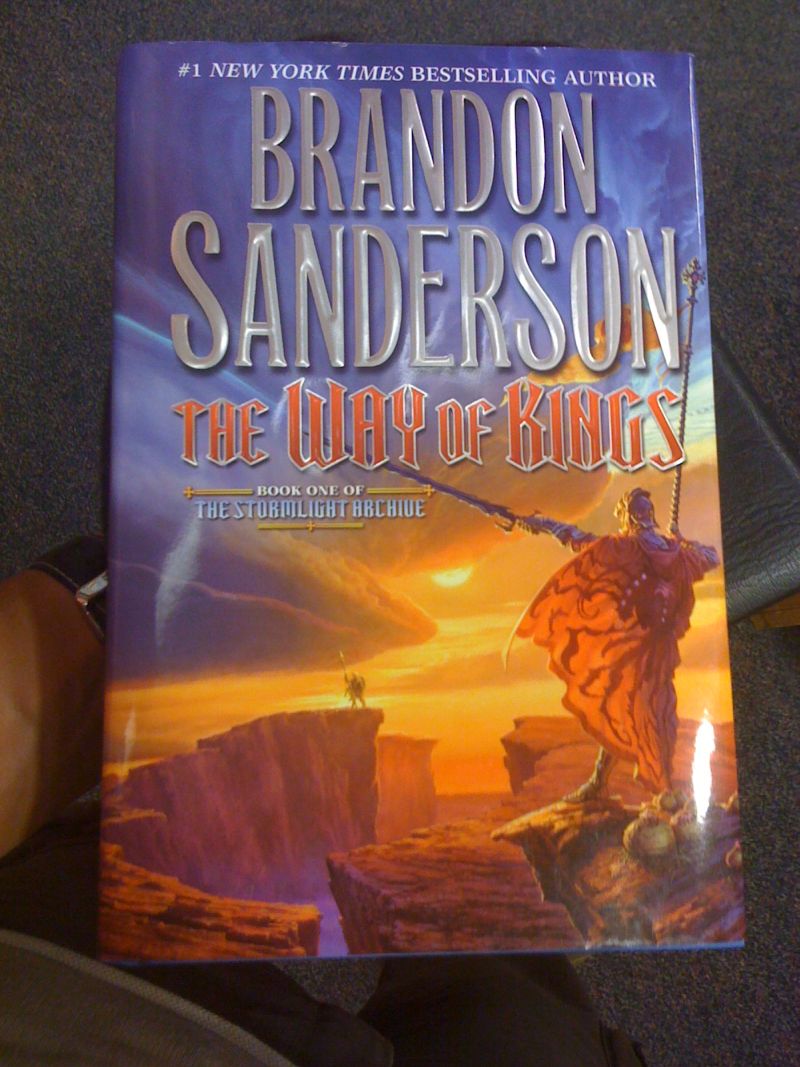
Book Review: The Way of Kings by Brandon Sanderson

Title: The Way of Kings
Author: Brandon Sanderson
Paperback: 1008 pages
Publisher: Tor Books - 31 Aug 2010 (US), Gollancz - 30 Dec 2010 (UK)
ISBN 10: 0765326353
ISBN 13: 978-0765326355
Series: Book 1 of The Stormlight Archive

"Roshar is a world of stone and storms. Uncanny tempests of incredible power sweep across the rocky terrain so frequently that they have shaped ecology and civilization alike. Animals hide in shells, trees pull in branches, and grass retracts into the soilless ground. Cities are built only where the topography offers shelter.

It has been centuries since the fall of the ten consecrated orders known as the Knights Radiant, but their Shardblades and Shardplate remain: mystical swords and suits of armor that transform ordinary men into near-invincible warriors. Men trade kingdoms for Shardblades. Wars were fought for them, and won by them.

One such war rages on a ruined landscape called the Shattered Plains. There, Kaladin, who traded his medical apprenticeship for a spear to protect his little brother, has been reduced to slavery. In a war that makes no sense, where ten armies fight separately against a single foe, he struggles to save his men and to fathom the leaders who consider them expendable.


Brightlord Dalinar Kholin commands one of those other armies. Like his brother, the late king, he is fascinated by an ancient text called The Way of Kings. Troubled by over-powering visions of ancient times and the Knights Radiant, he has begun to doubt his own sanity.

Across the ocean, an untried young woman named Shallan seeks to train under an eminent scholar and notorious heretic, Dalinar’s niece, Jasnah. Though she genuinely loves learning, Shallan’s motives are less than pure. As she plans a daring theft, her research for Jasnah hints at secrets of the Knights Radiant and the true cause of the war.

Speak again the ancient oaths,

Life before death.
Strength before weakness.
Journey before Destination.

and return to men the Shards they once bore.

The Knights Radiant must stand again."


Please find the rest of the review on Speculative Book Review...

Wednesday, October 13, 2010

Holidays

After 3 weeks of radio silence, I'm back. What happened? I went to San Francisco for work for a week. I go there every year to attend JavaOne (a big IT conference built around Java development platform). It all went well.

Then, I visited friends in Colorado for 10 days. This was my first time in Colorado and I was really looking forward to it. First I stayed with friends in Boulder. Then I went to Denver to stay with other friends for a few more days. What did I think of the place? I absolutely loved it.

The weather was amazing. We had 10 days of sunshine and blue sky. I'd love to see Colorado in winter, though, with all the snow and skiing. The people looked very much into outdoors activities.

We drove around the place a lot and while climbing the Rockies, we came across old mining equipment left from the mining era. I thought they looked cool, almost like out of a steampunk novel.

After coming back home for a few days, I left to attend the wedding celebration of some friends during a long weekend break. Now I'm tired but I had great time.


Well... Of course I did some reading during these busy times. I'm hoping to post my review of The Way of Kings on Monday.

Monday, September 20, 2010

Book Review: The Usurper by Rowena Cory Daniells

Title: The Usurper
Author: Rowena Cory Daniells
Paperback: 448 pages
Publisher: Solaris (2 Sep 2010)
ISBN 10: 1907519068
ISBN 13: 978-1907519062
Series: Book 3 of King Rolen's Kin trilogy

Now a slave, Piro finds herself in the Merofynian Palace where, if her real identity is discovered, she will be executed.

Meanwhile, Fyn is desperate to help his brother, Bryen, who is now the uncrowned King.

Bryen never sought power but now he finds himself at the centre of a dangerous resistance movement as the people of Rolencia flee vicious invaders. How can Byren defeat the invaders, when half his warriors are women and children, and the other half are untrained boys and old men?


Please find the rest of the review on Speculative Book Review...

Monday, September 13, 2010

Book Review: Century of the Soldier by Paul Kearney

Title: Century of the Soldier
Author: Paul Kearney
Paperback: 814 pages
Publisher: Solaris (2 Sep 2010)
ISBN 10: 1907519084
ISBN 13: 978-1907519086
Series: The Monarchies of God - Volume 2

The time of the wolf is at hand...

Struck down in his moment of victory, Hebrion's young King Abeleyn lies in a coma, his city in ruins and his fiancée and former lover vying for the throne.

Corfe Cear-Inaf, now a colonel, is given a ragtag command of ill-equipped savages and sent on a hopeless mission by a jealous King who expects him to fail.

Richard Hawkwood and Lord Murad return bearing news of horror on a savage new continent, with something terrible lurking in the hold.

The Church is tearing itself apart, even as the champions of truth fight to bring peace between Ramusian and Merduk; but in the far West, a terrible new threat is rearing its head...

The Century of the Soldier collects the final three books in Paul Kearney's explosive The Monarchies of God series, revised and expanded for this edition: The Iron Wars, The Second Empire and Ships From The West.


Please find the rest of the review on Speculative Book Review...

Tuesday, September 7, 2010

Losing Yourself in Malazan? Here's What Erikson Thinks

Even though I haven't read all of the published books of the epic Malazan Book of the Fallen series, I am a big fan of Steven Erikson and Ian Cameron Esslemont's work.

I remember when I started to read Gardens of the Moon, the first book of the series, I stopped after a few chapters and wondered if I had missed a few introductory chapters or a previous book. But I quickly appreciated Erikson's style. And over the years, I've heard how readers love to re-read Malazan books. These topics have been continuously discussed among the fans but now here's a chance to hear what Steven Erikson thinks about them:

I'd like to take you all back more than a few pages, and talk about why these novels seem to thrive in the context of re-reads, and why first-time readers are often left feeling bewildered. I think the two are very much related.

It goes back to how I first started writing fiction. I was in a Master's program in archaeology when I came second in a local short story contest in Winnipeg, a tale called 'Wooden Trucks.' On the weight of this one venture into writing I applied to attend a creative writing program at the University of Victoria. I recall being in a sweaty phone box in Belize, on the phone with my mother back in Winnipeg, as she opened the envelope telling me I'd got in. From that moment onward, my entire world changed.

The writing program at Uvic at that time was at its zenith. When I showed up it was as a wide-eyed neophyte with a secret love of genre fiction (one keeps these things secret if one wants to be taken seriously). What I learned, almost from day one, was that I knew nothing about anything; that my writing to that point had only 'worked' because I was instinctively consistent, with emphasis on the word 'instinctively.'

Uvic taught me the craft of writing; it taught me to be mindful. The key though is this: it made me a short-story writer. Short stories are a particular beasts. In them, not a single word is superfluous. Everything carries extra weight, or at least that's how I saw it.

Track forward a few years and scores of short stories later, and I begin writing novels, only to discover that my 'muscle memory' is now absolute -- the obsessive adherence to multifunctional, multilayered writing (line by line, word by word) is not something I can relax -- when novel writing in fact demands just that: an ease with wandering, with transitive passages, with a gentler hand taking hold of the reader, etc. Instead, novel-writing for me is the building of ever more elaborate structures, designed to carry ever more weight.

A long ramble to get to this: on one level details in making a setting carry the more obvious virtues -- placing the characters somewhere, giving them things with which they can interact; in creating an atmosphere and a tone; and in painting a picture for the reader's imagination. But other levels are possible. Setting as 'animated environment' can feed your sense of the characters in it; can foreshadow elements of plot; can reveal theme.

Take some opening scenes in Gardens as examples, and see how they relate to subsequent scenes for those select characters. Whiskeyjack and Fiddler on Mock's Hold: high above a burning city, in a place of power. There's smoke and the smell of carnage -- they are above it but only moments from descending into it. But we don't see that bit. They are on stonework, but it's cracked, and their backs are to the sea. All of these details shapes the reader's sense of them to some extent. When next we see them, they are on the ground, far away from Malaz City, surrounded in destruction and desolation. It's a different place, but their descent began in the prologue, if you see what I mean. And even then, they were only a short time earlier under the ground itself.

If we look to Kruppe, things get a little more complicated. Kruppe and his city are the same things; just as his language and attitude (and mystery) reflect the exotic, byzantine confusion of Darujhistan, so too his half-mocking smile and spark in the eye invite you into the labyrinthine cityscape (and the literally over-the-top assassin/Crokus chase). Kruppe is both flashy but on close examination somewhat scuffed, stained. He has a cherubic face, but plenty hides behind that. And so on. His voice is the city's voice, and it begins in a dream, as all great cities do.

Where is all this going? It goes here. Three storm clouds converging over Lake Azure, into which Whiskeyjack and co. are headed. A reader comments that I'm too smart to now say that there was deliberate portent in the detail of three clouds warring over the lake. Hmm. It's been too many years since that for me to be more specific than this: I could have written 'there was a storm over the lake,' and left it at that. The foreshadow is obvious enough. But, if I'd written that description, I would have immediately seen the foreshadowing element -- it's almost too cinematic and verges on cliche. I could then have changed it to two storm clouds, but then, that wouldn't have made sense; or rather, it would have been suggestive but inaccurately so. There are three forces converging on the city. Two storm clouds would have been lazy and misleading; careless.

Of course there are three storm-clouds. Of course this detail is relevant. It's how short stories work.

Uh oh. This ain't a short story though, is it? And therein lies the problem. I know what I'm up to; I know how I think and how I write. And to make matters worse, everything I put into a narrative is saying (pleading, begging) 'you can trust me, honest.' But I'm not taking the reader by the hand. I've invited them into a place, left them standing, looking round, wandering a bit but not far, not far at all. And every now and then I tap a shoulder, point, nod to over there, or here. And that's it.

Re-readers will nod and smile. First-timers will blink, bewildered -- and will decide to either trust me or not. I really want them to trust me, but I don't know how to manage that... beyond making sure that everything fits, that everything has meaning.

A virtue or a flaw in my writing? Maybe both. You see, I already know that world, but the only details I show you are the important ones. There's no filler. And that's not fair.

And the structure is such a crazed, manic machine, an engineer's nightmare, a spider's acid trip, it's really no wonder that readers will doubt, and on occasion give up on the effort, on the trust I so desperately ask for.

So, to all you new readers on this, I am ever amazed and slightly astonished to find you staying with me. I tell myself that what is happening is a kind of education process: read me this way, it's the only way. Pay attention! You will be tested on all of this, I guarantee it. Stay with me and in turn I will promise you that it will be a blast.

And even better, then you'll have all those re-reads, when things will really get wild.

You can find the entire article on Tor.com - The Malazan Re-read of the Fallen: Gardens of the Moon, Chapters 16 and 17

Monday, September 6, 2010

Book Review: The Uncrowned King by Rowena Cory Daniells

Title: The Uncrowned King
Author: Rowena Cory Daniells
Paperback: 448 pages
Publisher: Solaris (5 Aug 2010)
ISBN 10: 1907519041
ISBN 13: 978-1907519048
Series: Book 2 of King Rolen's Kin trilogy

Thirteen year old Piro watches powerless as her father’s enemies march on his castle. A traitor whispers poison in the King’s ear, undermining his trust in her brother, Byren.

Determined to prove his loyalty, Byren races across the path of the advancing army, towards the Abbey. Somehow, he must get there in time to convince the Abbot to send his warriors to defend the castle.

Meanwhile, the youngest of King Rolen’s sons, Fyn, has barely begun his training as an Abbey mystic, but he wakes in a cold sweat, haunted by dreams of betrayal...


Please find the rest of the review on Speculative Book Review...